 |
| Female biorobot |

 OctoMY™ Supports Ukraine!
https://u24.gov.ua/
OctoMY™ Supports Ukraine!
https://u24.gov.ua/
This is the official blog about the development of OctoMY™, the robot platform for you!
2014-01-04
New biological robot.
I have made yet another awesome biological robot. This time it is a female. I fall in love with her every time I see her. She is already playing nice with the one I made earlier.

2013-08-19
Robot leg anatomy
Here is (mostly for my own reference) a simple glossary for the parts that go into a very simple robot leg, with illustration.
The leg is divided into 4 parts:
In my robot, there is no Foot, I just included that for completeness. Also this referece lacks any mention of joints or muscles (actuators). I simply lists the bones or "links".
I used wikipedia and this site for inspiration and reference: http://bugs.osu.edu/~bugdoc/Shetlar/462/462InsectMorphology/Morph03.htm
The leg is divided into 4 parts:
- Hip (Coxa)
- Thigh (Femur)
- Shin (Tibia)
- Foot (Tarsus)
In my robot, there is no Foot, I just included that for completeness. Also this referece lacks any mention of joints or muscles (actuators). I simply lists the bones or "links".
 |
| Anatomy of robot legg showing Hip, Thigh, Shin, Foot (Coxa, Femur, Tibia, Tarsus). |
2013-08-18
Good bye ODE, hello GEAR!
I eventually grew tired of ODE's inability to handle cyclic graphs well, and looked for alternatives. Apparently cyclic dependencies in the constraints is a difficult problem to solve so very few solutions exist that will work. Luckily I found an alternative called GEAR (Geometric Engine for Articulated Rigid-body simulation) which was made with cyclic graphs in mind. GEAR is an implementation of a a novelty algorithm using some fancy new stuff called "lie group formulation for articulated rigid body dynamics". The code speaks for itself. Mr. Jinwook Kim who made the original, and Mr. Junggon Kim who adapted it to his use (and from what I can see, extended/simplified the code a bit) really know what they were up to. It seems to use more is nearer to use some basic C++ features and lacks the silly "C <--> C++ <--> C" wrapping of the ODE API. There seems to be no documentation what-so-ever, except for the extremely math-intensive and otherwise dense paper, and code comments are sparse. But the demos are stunning! Please check out the videos on this page.
I will make my best effort to use this code in my project, and if I am lucky, it will perform under my demands. One hurdle that I will have to get around is the lack of collision detection and handling, however there is some code for that on the video page that I might be able to adapt.
UPDATE: gear was moved to github.
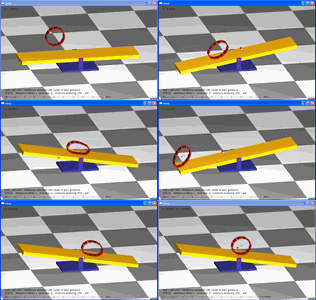 |
| "Sloop" demo of GEAR |
UPDATE: gear was moved to github.
2013-08-13
Riftcam
I have previously written about OpenGL code for the ocular rift, and Now after receiving my own I have yet to go further with writing the perspective correction code. The truth is that even if the rift is one awesome piece of gadget that I believe will change the way we interact with computers in the near future, I still have a strong mandate in this project that I have to prioritize, and that is to build my robot. Until I actually need the rift for something in my project, It will be sitting in its box.
That being said, I have contacted several surveillance camera manufacturers on Alibaba with requests about creating a stereo vision PTZ dome camera with oculus compatible wide angle lenses. I actually had some response in this regard. I will keep this blog updated.
 |
| Oculus rift illustration |
ODE instability
Adding the actuators to my ODE model proved much harder than first anticipated. Even with all the stability-enhancing features of ODE cranked up to the max (really small step size, CFM and ERP set high, unit size bodies, masses etc.) my model completely explodes. I think the reason is that when I pose the model, it is not completely still, and the abrupt movement caused by the spike in error correction at simulation startup simply blows out of proportions.
I will work on it some more before giving up on it. One idea is to engage the actuator bodies after the rest of the model has settled. Maybe assembling the model in zero gravity will help as well. But so far it is not looking good for this project. :-( I was hoping that ODE would play nice. I have used it a lot before, but then I mostly played with the collision detection and building large structures out of blocks to see how they would collapse, which ODE handled splendidly.
In my frustration I went looking for alternatives and found this excellent collection of hexapod code by 12Cent Dwarf
 |
| Open Dynamics Engine (ODE) exploded simulation due to instability. |
I will work on it some more before giving up on it. One idea is to engage the actuator bodies after the rest of the model has settled. Maybe assembling the model in zero gravity will help as well. But so far it is not looking good for this project. :-( I was hoping that ODE would play nice. I have used it a lot before, but then I mostly played with the collision detection and building large structures out of blocks to see how they would collapse, which ODE handled splendidly.
In my frustration I went looking for alternatives and found this excellent collection of hexapod code by 12Cent Dwarf
Subscribe to:
Posts (Atom)